Unifying a fragmented
CPaaS into a single
product surface.
How I led the product strategy and UX rollout of MyLINK Portal across six European markets — and built the team, processes and political trust required to make organisational change actually happen.
A decade of acquisitions left LINK with dozens of products, no shared infrastructure, and no shared experience.
What customers experienced
What was broken internally
The people who most needed this change were the most exhausted by the fact that it hadn't happened yet. That was the environment I walked into.
Hired as PM. Promoted to VP of UX within a year. Building product, team, and process simultaneously.
Six moves, in order. Each one earned the next.
My first major test came early: a strategy workshop in Copenhagen with the company's senior managers. I was 30, the only PM in the room, surrounded by men in their 40s who had been debating these problems for years. The conversation was going in circles — arguments about what constituted a product versus a feature, about ownership and priorities.
At some point, my manager and the Head of Commercial were stuck. A long silence. I asked one question:
“Would this be upsell or upgrade?”
The room changed. That distinction — between selling into an existing plan and moving a client to a new one — had been invisible in the conversation, but it unlocked an entirely different way of thinking about the product offering. We spent the next hour restructuring the map.
That workshop taught me something I've used ever since: in politically charged rooms, a well-placed question does more than any argument. I came to every subsequent meeting with something prepared to show — a wireframe, a prototype, a framework — and with a set of questions ready for moments when showing something wasn't the right move. I listened first, always. Then I taught. Then I asked.
Before touching any feature or sprint, I worked with the Head of Product to translate executive strategy into something the organisation could actually execute. The output was a product Blueprint — a document that defined what the portal was and was not, which legacy products would be migrated and which would be sunset, what the value proposition was for customers and for LINK internally, and how success would be measured.
This Blueprint became the north star for every subsequent decision. When stakeholders pushed for out-of-scope features, I pointed to the Blueprint. When engineering proposed solutions that diverged from the strategy, the Blueprint anchored the conversation. It is still the reference document today.
I also ran a naming and principles workshop early on — a deliberate move to give the project a codename and a shared identity. It sounds small. It wasn't. Teams defend what they helped name.
I was given a UX and frontend team assembled from a recently acquired company in Macedonia. They were talented but disconnected — from each other, from the product, from the broader organisation. Before we could design anything meaningful, we needed a shared way of working.
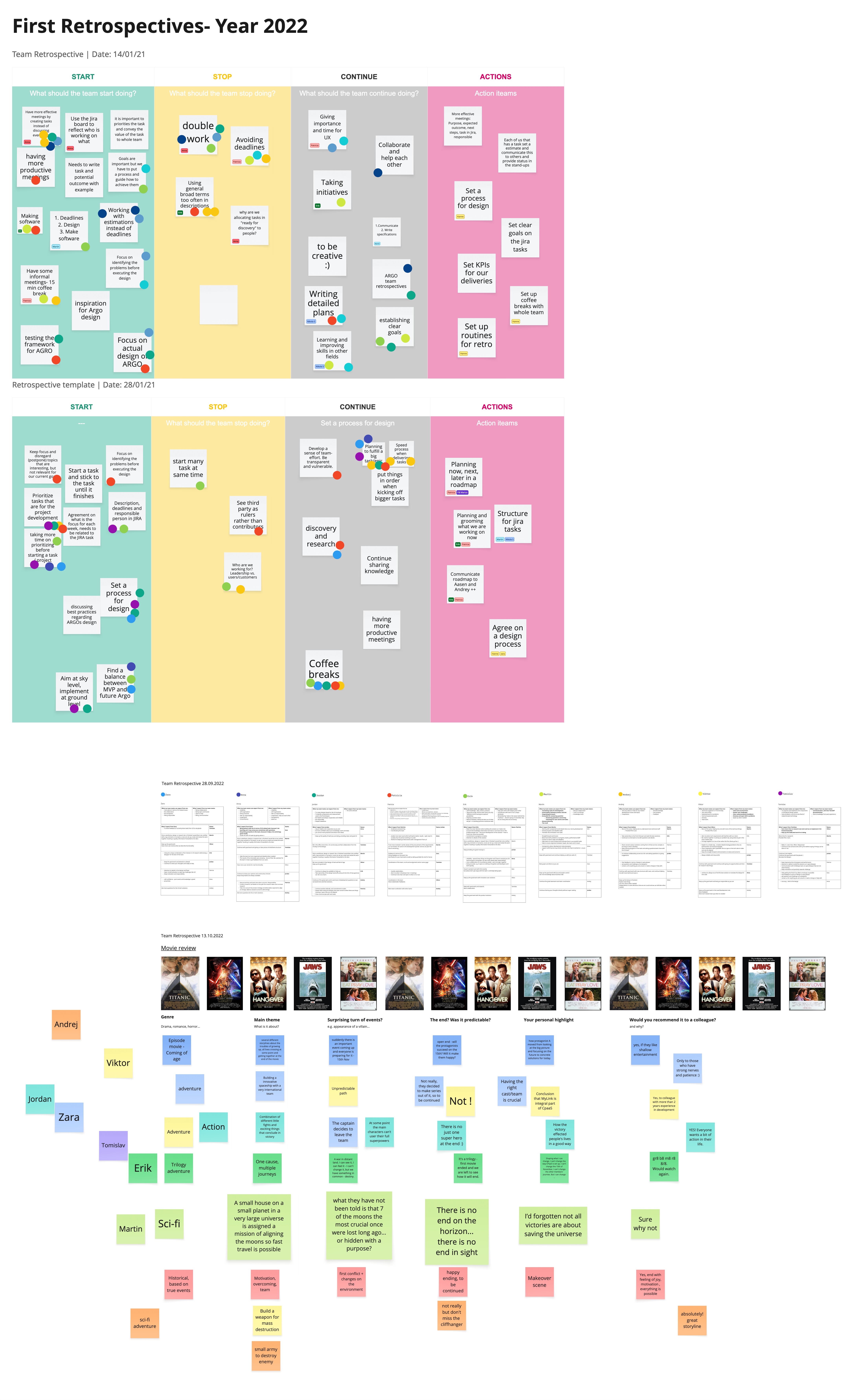
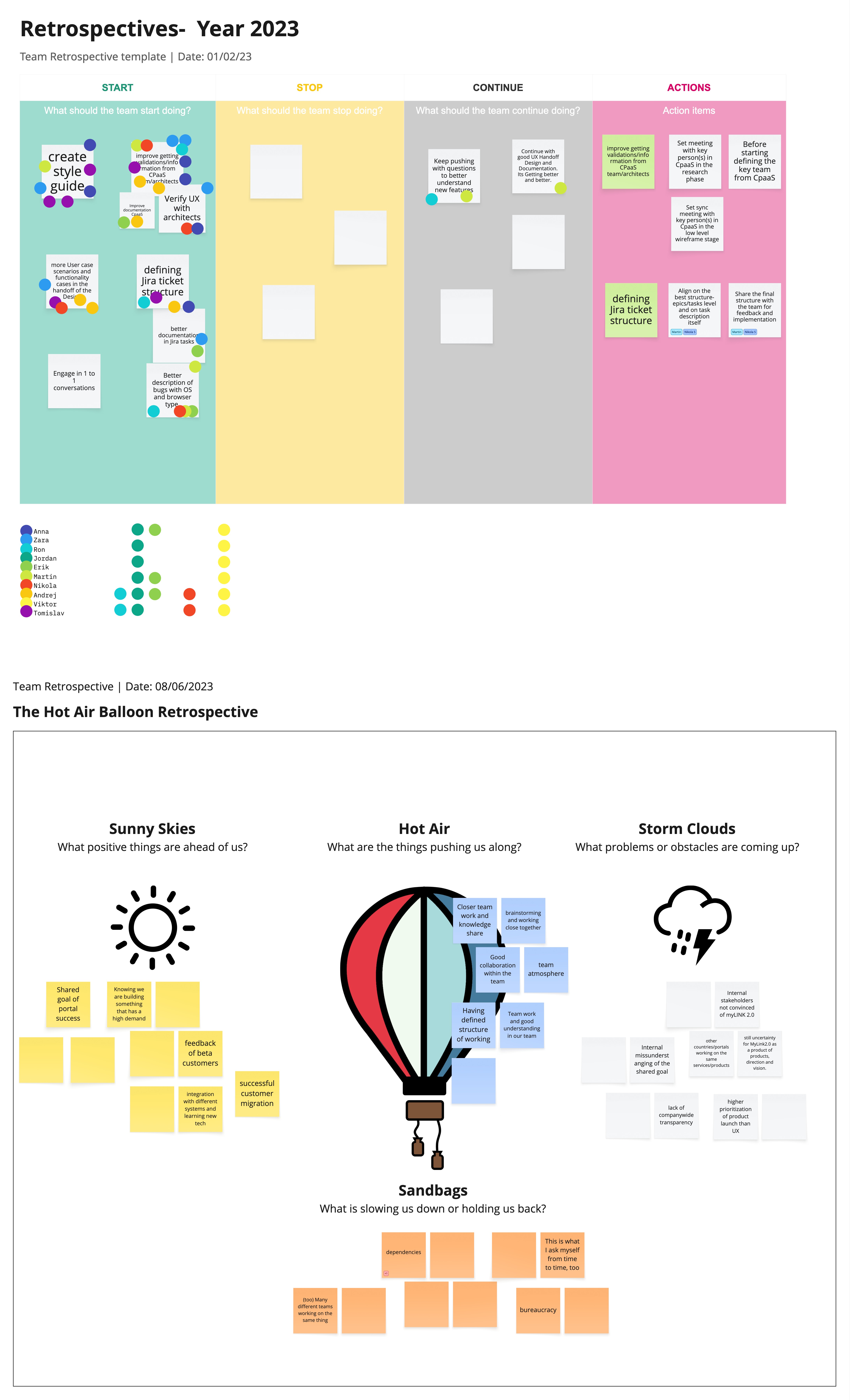
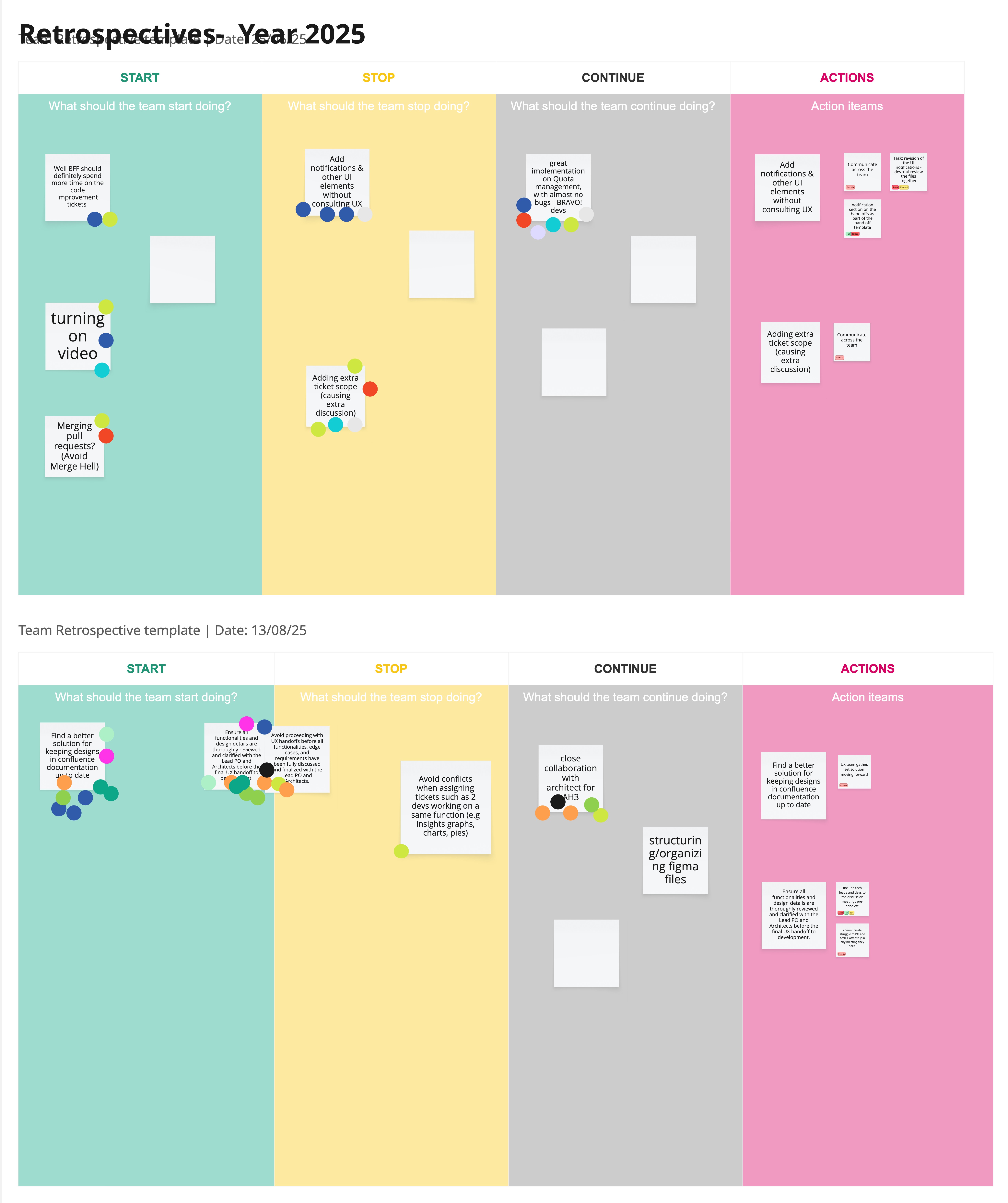
I started with fortnightly retrospectives — joint sessions with the UX team and the Macedonia tech team together. Not to review deliverables, but to surface the friction in their daily work and systematically reduce it. The frequency of retros tells its own story: we needed them every two weeks at the beginning. We now meet monthly. The problems didn't disappear — they shrank.
I then built a complete UX process from scratch: documented in Confluence, with Figma templates for every project type, with clear definitions of what research meant, how prototypes connected to engineering specs, how feedback loops worked. I invited the more resistant team members to contribute to the process rather than receive it. People defend what they help build.
I also requested that HR run a team dynamics workshop — a structured process to surface how we worked together. Some people left after that. The team that remained has been stable ever since. No one has left. That's a metric too.
Before a single wireframe was drawn, we ran an exhaustive discovery process. We interviewed internal support teams across multiple markets. We analysed existing products, mapped customer personas, spoke directly with clients, and ran a full competitive analysis. We mapped the entire portal architecture — coordinating with every product team to understand their use cases and integration requirements.
From that research, we defined the core problems the portal needed to solve, built and iterated through multiple versions of the concept, and used rapid prototyping to test ideas with management before committing to development. I introduced tools to record and analyse client feedback from meetings systematically, and fought to add product analytics tracking from day one — something that required sustained advocacy inside a company that historically measured very little at the product level.
The prevailing assumption was that migrating clients between products caused churn — and that this was unavoidable. I disagreed with the diagnosis. The problem wasn't migration. It was forced migration.
I proposed a soft migration strategy: first connect client data to the new portal so they could see their existing information there. Once they were logging in regularly and seeing value, introduce the new product capabilities alongside. The migration became a natural next step, not a disruption. Clients began requesting it themselves.
No product could enter the portal without following the unified provisioning process and invoice structure. The billing chaos had to stop at the gate, not downstream.
With local market managers: always left conversations with a solution and a concrete action plan — never just a diagnosis. Speed of response built credibility that arguments couldn't.
With the engineering team: showed them — incrementally, specifically — how structure in the roadmap made their work easier. Found allies inside that team and made those people visible.
With C-level stakeholders: experimented constantly with format. Presentations, wireframes, metaphors, videos, journeys narrated in the client's voice. Whatever it took to make the abstract concrete.
The numbers tell part of the story. The rest is organisational.
Unique users
Across 6 European markets
Avg. session duration
14% bounce rate — strong for B2B enterprise
Legacy products
Migrated or sunset — 91–100% completion in Nordics
Markets launched
Norway, Denmark, Finland, Sweden, Spain, Global Sales
Team departure
In 4 years — the Macedonia team has since grown
Open billing exceptions
Provisioning unification ended the daily financial fires
Support teams now have a single surface to manage client issues — and have become advocates for the portal, not resistors. Product managers across the company have started embedding UX research into their own processes. The provisioning and invoice unification means billing exceptions are an anomaly rather than a daily fire.
This project is still in progress. There is more to build. But the foundation — the Blueprint, the team, the process, the trust — is solid enough that it can grow without me carrying it alone. That might be the result I'm most proud of.
Political rooms don't respond to arguments. They respond to momentum.
The hardest part was never the product. It was the organisation. I had to manage in three directions simultaneously — building confidence in a team that had been under-resourced, bringing along stakeholders who had been disappointed before, and maintaining credibility with leadership who needed to trust that the investment was worth it.
The thing that worked, consistently, was arriving prepared. Not just with a plan, but with something to show. And when showing something wasn't right, with questions that changed the direction of the conversation. Political rooms don't respond well to arguments. They respond to momentum. I learned to create it.
The Blueprint wasn't just a product document — it was a political tool. A written, agreed-upon north star made every difficult conversation easier. The debate was with the document, not with me.
I was perhaps too trusting with certain stakeholders early on. I assumed good faith where there was none, and it cost time. I've learned to read the room earlier — to distinguish between genuine resistance and political positioning — and to act on that difference sooner.