Turning private data
into a public ranking —
and a growth engine.
How we took Alqua's most compelling internal asset — a digital brand ranking across thousands of companies — and turned it into a product-led acquisition engine that brought the right prospects to us before the first sales call.
Alqua had data thousands of brands didn't know existed. We decided to change that.
Alqua's platform held a significant data asset. Thousands of brands across multiple industries and countries, analysed continuously across social media performance, influencer campaign efficiency, media presence, audience perception, and digital brand value. This data powered our core product — but it lived entirely inside the platform, visible only to paying customers.
We noticed something in client demos. When we showed prospects the internal ranking — which brands were leading their sector digitally, how they compared to competitors, how positions shifted over time — the reaction was consistently strong. People leaned in. They wanted to know where they ranked. They wanted to compare. The competitive instinct in marketers is powerful, and we had data that triggered it directly.
The question we started asking was simple: what if this data didn't just live inside the product? What if it became the product? The Alqua Digital Index was our answer — take the most compelling part of our platform and make it publicly visible, with carefully designed access limits that created a natural path from curiosity to conversion.
A public ranking engineered to generate leads. Two phases, deliberate friction.
Before the product could work as a lead magnet, it had to be credible as a ranking. That meant the algorithm had to be rigorous. We spent significant time refining the Alqua Digital Index formula — a composite score measuring digital brand impact across multiple dimensions: social KPIs (followers, engagement, post volume), influencer campaign efficiency, media presence, audience perception, and monetary digital brand value.
The formula went through multiple iterations. We introduced logarithmic scales to handle the enormous variance between large and small brands without large players dominating purely on volume. We built category, sub-category and niche taxonomies covering industries across Spain and Latin America, so rankings were meaningful at every level of specificity — a brand could see not just where they stood in Beauty broadly, but in Skincare, or in Natural Cosmetics specifically.
The credibility of the index depended on this rigour. A ranking that felt arbitrary would generate curiosity but not trust. A ranking that felt methodologically sound would generate the kind of engagement that leads to a sales conversation.
The first version of the ADI was a downloadable report: a designed, data-rich PDF ranking the top brands in a given industry for a given period. We produced reports by sector — Beauty was one of the first, analysing 2,650 brands and ranking the Top 200.
The reports were marketed through a landing page with a single conversion wall: to download the full report, you had to provide your contact details. The content was the incentive. The registration was the cost. This gave us a qualified list of people who cared about digital brand performance in a specific industry — exactly the profile of our ideal customer.
The report was a start, but it had a fundamental limitation: it was static. A brand's position in a quarterly report told you where you were — but not how you were trending, who was overtaking you, or what was happening right now.
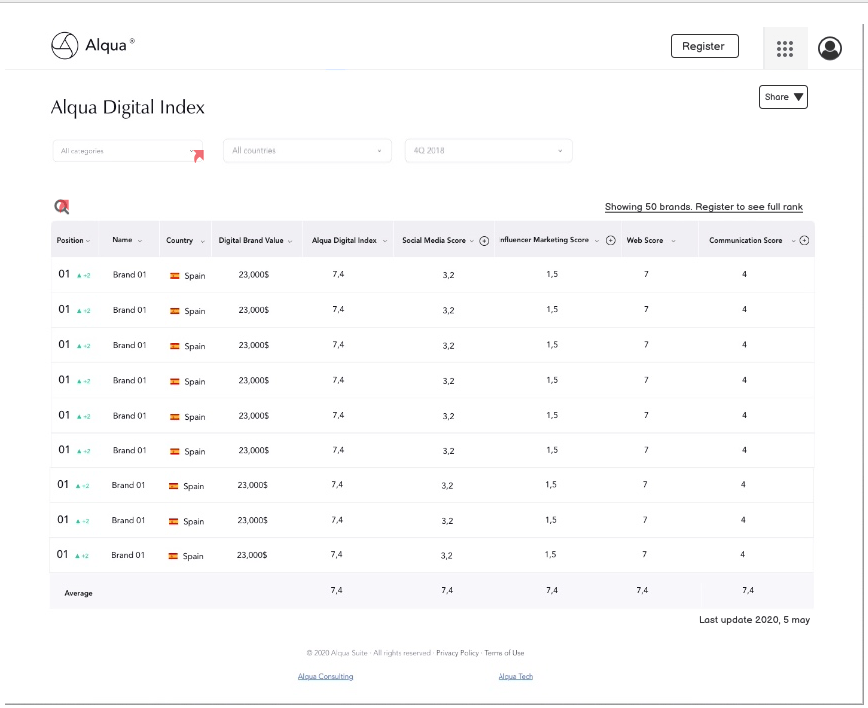
We built the ADI as a live, interactive tool on the Alqua website. Users could explore rankings by industry, sub-category, niche, time period, and country. They could search for specific brands. They could see how positions changed over time. But not all of it. The conversion architecture was built in layers:
- AnonymousLimited brands per ranking — enough to understand the value and see their own position, not enough for serious competitive analysis.
- RegisteredFull ranking access, plus a timed modal promoting the latest sector report as a downloadable PDF.
- ConsultationA direct path to a sales conversation — always visible, for users who had seen enough to want to go further.
Every access limit was designed to create a specific kind of frustration: the productive kind, where you can see the value of what you can't fully access yet. The wall wasn't there to block — it was there to motivate.
This wasn't a marketing initiative. It was a product decision with distribution built in.
What I find most interesting about this project, in retrospect, is that it wasn't a marketing initiative with a product wrapper. It was a product decision that had marketing consequences.
The distinction matters. A marketing initiative asks: how do we attract more leads? The answer is often more content, more ads, more channels. A product initiative asks: what is the most valuable thing our product does, and how do we put that value in front of people who don't yet know we exist? The answer, in our case, was to make our data public — with limits that turned curiosity into demand.
This framing came directly from reading about product-led growth and the concept of using the product as a distribution channel. The idea that the most powerful form of marketing is letting people experience a version of what you've built — and wanting more — shaped every design decision in the ADI.
The ranking itself exploited a specific psychological dynamic: competitive benchmarking. Brands don't just want to know their absolute performance. They want to know how they compare to their competitors. The ADI made that comparison visible — and then limited it just enough to make the full picture worth paying for.
Prospects came to us already convinced. The sales conversation started from a different place.
Brands analysed
In the Beauty sector alone — Spain & Latin America
Ranking per report
Specific enough to feel exclusive, broad enough to be relevant
Conversion layers
Anonymous → registered → consultation — each moving users forward
Phases to market
Automated PDF report first, live interactive tool second
Registration gate
A single friction point calibrated to maximise conversion
Outbound required
Qualified prospects came to us having already experienced the product
The ADI changed how we acquired customers. Instead of our sales team going out to find prospects, prospects came to us having already experienced the product. The sales conversation started from a completely different position — not “let me tell you what Alqua does” but “you've already seen what Alqua does; let's talk about what you need next.”
Data you already have is often more powerful as a public product. Keeping it inside a paywall limits who can ever discover your value.
Data you already have is often more powerful as a public product than as a private feature. Keeping data inside a paywall protects revenue in the short term but limits the audience who can ever discover your value. Making a version of it public — with the right access limits — generates more qualified leads than any outbound campaign.
Conversion architecture is product design. Every decision about what an anonymous user can see, what a registered user unlocks, and where the consultation button sits is a UX decision with direct revenue consequences. Getting those decisions right required the same user understanding as any other product decision.
The algorithm work was a lesson in the relationship between credibility and adoption. A tool people don't trust won't generate leads regardless of how well the conversion walls are designed. The investment in rigour — the logarithms, the category taxonomy, the iterative refinement — was an investment in trustworthiness. Without that foundation, nothing else would have worked.
“The most powerful form of marketing is letting people experience a version of what you've built — and wanting more. The ADI wasn't a campaign. It was a product decision with a distribution strategy built in.”